Hi,
I have been searching around the forum trying to find a description of how to fix the damage between the cone/tube joint on my searider 5.4. The area appears to have been repaired before, and came apart on my maiden voyage of this restoration project. I know the tubes are pretty beat up, and I am planning on replacing them next year, but I would like to keep them going through the summer. I saw the thread of putting in new stubbie tubes and it seems like a great fix, but I am hoping to do this inexpensively as I will likely scrap these tubes in the foreseeable future. I have made a sketch showing a detail of the damaged area.
Any help would be great!
Thanks!
Exactly the worst place to have damage, as you'll know from reading my thread. I think patching it will be nigh on impossible due to the beating it takes from the water.
My 2p is I'd cut your losses and get new tubes now. I'd have done that if I had anybody here that could re-tube mine when it went.
__________________
A Boat is a hole in the water, surrounded by fibreglass, into which you throw money...
I'm going to have to put in the exact same spot very soon. My tube isn't leaking yet but the grey outer to my rib skin has come off leaving the meshlike material.
Because of the area I was going to make the patch as big as possible to ensure the lip of the patch isn't being hit by the water. I've never done it before so no idea how it will turn out.
Does anyone know who I should contact about getting a patch?
Thanks
Dan
If you can get the main tube airtight then the best bet for protection would be large triangular wear-patches as fitted to some other boats. My new Vmax is going to get those after the problems I had!
Something like the black ones on Campbell's Vmax pictured below. The idea being that the leading edge of the fabric is more or less along the water flow instead of a hard edge against it.
I am sure Paul Tilley (Tidel), Henshaws or Eurocraft would make them for you.
__________________
A Boat is a hole in the water, surrounded by fibreglass, into which you throw money...
Wow, thanks for all the help!
I spent a little more time investigating the damage and realized that the cone and the entire joint was in really poor condition. The cone-tube joint basically fell apart and looked like it had been glued before, and the cone had a layer of hypalon glued over the top which was completely delaminated. I have pulled off the entire cone, and started to clean up the bonding area. I am thinking of making a new cone by carefully tracing the old one's panels, and then bonding it into the tube. Before bonding it in, I am thinking of cutting out part of the tube which is damaged, and then using this as an access for the cone bonding and patching this last. Then adding a large V patch to finish it off.
Any advice, words of warning, or tips? I am aware to check the warp and weft of the new hypalon when patterning, and I have some clifton adhesive.
Thanks,
I tried and failed to glue a new cone end in mine. I wouldnt dream of trying it if I could get a grown-up to do it for me.
The idea is simple, but the reality is ending up with large parts of yourself glued to either the boat or the floor, leaving various bits of hair behind, swearing a lot and ending up with a bigger mess than you started...
__________________
A Boat is a hole in the water, surrounded by fibreglass, into which you throw money...
I've learned to do very difficult tbe repairs in very difficult circumstances (back deck of a boat at sea). If I don't get a fix I'll be unemployed so I have a very positive attitude to repairing toobs.
These are the most important tols for the job, as if the prep is right then the sticking is good and the job is good I'm hoping that the toobs are not delaminating by themselves as this is impossible to fix.
Using the old bits for a template is sensible as it would be too difficult to cut by eye.
i'll write the rest of the stuff later when i come off watch
__________________
Here it comes again, I don't stand a chance
Soul possession, Got me in a trance
Pullin' me back to you - Deja Voodoo
Thanks for the info so far!
I have gotten a sanding drum to attach to my drill with some 80 grit which works surprisingly well at preparing the surface. I will also get some toulene to prep before gluing. I am interested to learn about techniques to actually do the bonding, I know the required glue process, but i could use some tips in actually putting the pieces together, where to start, how to keep the parts from sticking to each other etc...
I have thought about inserting a beach ball into the tube a little forward of the repair and inflating it to keep the inside surfaces from sticking to themselves when collapsing?!
make a former by cutting ou two circles from 3/4 inch MDF the same diameter as the inside of the toob. stick them together and cut an inside circle an inch smaller than the outer circle. Cover the 1 and a half inch former with hypalon glue up half the former and the inside of the existing tube. this presents you with a solid unglued hypalon former protuding 3/4 of and inch from the rear of the toobs which your tube nose fits on.
Glue the nose and the remaining half of the former and stick together
reinforce the joint with exterior band of hypalon
__________________
Here it comes again, I don't stand a chance
Soul possession, Got me in a trance
Pullin' me back to you - Deja Voodoo
I should have made it clear that this is to support the join not replace it so the new nose cone should be stuck to the old toob in the same place as it was prior to deconstruction. You might also need to shape the former a bit to take account of the toob taper
__________________
Here it comes again, I don't stand a chance
Soul possession, Got me in a trance
Pullin' me back to you - Deja Voodoo
I have successfully done the repair this weekend, and thought I would share some of my experience:
First, I pulled apart the seam between the cone halves and the tube which was badly damaged. Then, I pulled apart the cone halves and removed them from the rubber end cone bit. This was a little tricky but not too bad with a heat gun.
Next, I started to clean the joint on the tube-side and realized the damage was bad enough to also remove a bit of the cone. I cut off about two inches off the end of the cone which gave me good material to bond to. I ordered some Hypalon from Clavey which didn;'t quite match the Avon color, but seemed to be ok. The cone parts as well as the bit I removed from the tube were traced onto the hypalon with 1" bond-overlaps added to the strip cut from the tubes. I matched the weave and weft direction on the cone bits, and cheated a little on the long strips to reduce off-cut.
Re-assembly proved to be extremely tricky, and I would not try this without having at least two helpers. I also put an inflatable beach-ball into the tube to hold it open which helped a lot, and which I could remove before the final bond.
Re-Installation:
1. Bond the two cone triangles to each other and onto the rubber end bit.
2. Bond the tube strip to the tube.
3. Roll up the bottom half of the cone and tape it so its out of the way.
4. Bond the upper cone half to the tube.
5. Use a marker to index the corner of the bottom tube (the final circumferential bit) so that the cone-tube joint, and the joint between the cone halves will fit.
6. Bond the lower cone halve to the tube, accessing the inside of the tube though the open joint between the cone halves.
7. Remove beach ball, deflate and bond cone halves together.
8. Lightly inflate and let cure.
9. Measure, cut and glue the overlap bits.
Just in the interest of keeping this going, I can report that the above mentioned repair is holding up well after 4 days in the water and probably about 40 miles in moderate seas. Unfortunately the other cone started coming apart now, and filled the tube up with about 20 gallons of water. In this case, the joint was in slightly better condition than the starboard one, but the material was still pretty shot, so I decided to make a 5" slit on the tube where the AVON logo used to be and apply a patch from the inside. This allowed me to keep the cone on the boat as I didn't want to go through re-gluing a cone again if at all avoidable.
I also made some triangular patches on the starboard side, and will put one over the internal repair on the port side as well. Ill try to upload some photos soon.
so far, this has been much easier than the full replacement, but it remains to be seen if and how it holds up....
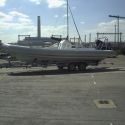
Here are a few photos:
1. The reinforcement patch on the SB side. I used some thick clear foil (available in painting stores to tape off walls) to pattern the piece such that it fits snugly against the overlapping hypalon bit that attaches the tube to the hull. This way, there is no edge for the water to spray against. When placing the patch down, I had a slight overlap which I cut down with a very sharp kitchen knife. Once trimmed, the patch laid down exactly next to the existing reinforcement making a smooth surface.












 White Noise
 I'm hoping that the toobs are not delaminating by themselves as this is impossible to fix.