 |
|
 01 May 2007, 20:53
|
#1
|
|
Member
Country: UK - England
Town: Gloucestershire
Boat name: Osprey
Make: Osprey Vipermax
Length: 5m +
Engine: E-tec 300 G2
MMSI: TBC
Join Date: Dec 2006
Posts: 4,020
|
Radar Reflector
Ive just bought one of these from Rib-shop.....
http://www.rib-shop.com/product.asp?...hFor=&PT_ID=21
Can anyone recommend the best place for it on my Aframe the instrcutions on their website say to use cable ties so would I mount it against one of the verticals on the A frame or across the Top in a horizontal position?
Chris
__________________
|

|

|
|
01 May 2007, 22:09
|
#2
|
|
Member
Country: UK - England
Town: River Hamble
Length: 6m +
Join Date: Oct 2005
Posts: 726
|
Hi Chris,
The higher you can get it, the better. We normally try to fit them across the top bar of the A frame. Hope this is of use, if you need more info, just PM me, e-mail us or give us a call.
Thanks
__________________
RIB REPAIRS | RE-TUBES | RE-FIT - OUTBOARD SERVICING - ONLINE SHOP FOR RIB & TOHATSU PARTS .
Phone: 01489 556800 www.rib-shop.com |
|
|
|
|
01 May 2007, 22:32
|
#3
|
|
Member
Country: Ireland
Town: Galway
Boat name: rockhopper
Make: ballistic
Length: 6m +
Engine: petrol
MMSI: TBC
Join Date: Nov 2006
Posts: 525
|
Unless something has changed in the past few years, you may not want to use this too often at head level due to the radiation. However in fog I am sure it would be useful.
__________________
|
|
|
|
|
01 May 2007, 23:32
|
#4
|
|
Member
Country: UK - Scotland
Town: Inverness
Boat name: none
Make: none
Engine: none
MMSI: none
Join Date: Mar 2007
Posts: 1,908
|
I am not sure what you mean, it doesn't emit radiation. If there is that much radiation from emitters in the area then any reflections from one of these would be the least of my worries.........
I have the powerboat version of this fitted high up on my frame with a home made stiffener to brace the mounting lug.
This is the old smaller version before I fitted the larger diameter version, only because the wife ran us under the prow of a yacht in a marina and snapped it off! The large diameter version I have now is mounted the same way.
BTW, I am not entirely convinced it really works any betetr than the outboard itself as a radar reflector..............
__________________
|
|
|
|
|
02 May 2007, 03:10
|
#5
|
|
Member
Country: Canada
Town: Tobermory, Canada eh
Boat name: Verius
Make: Zodiac Hurricane 590
Length: 5m +
Engine: Yamaha F150
Join Date: Oct 2006
Posts: 1,366
|
I have the big brother to the one you bought. I have had a couple of those smaller ones that mount to a little leg... Neither lasted a season as that bracket just wasn't up to the pounding it took on a RIB. I believe those smaller jobs are meant for sailboats where they can be tied to the rigging. I agree it needs to be attached at both ends. For some reason, I was under the impression that these are to be mounted vertically for best results...
The larger odel is about 4" wide and attaches with four bolts. This one las lasted about 5 years.
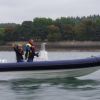
As for whether they help or not, I can tell you that friends with radar tell me that my boat casts a shadow about the size of a 60 foot steel boat. I have it mounted to a platform on the top off my A-frame. The higher it is , the better it will work. I've attached a lousy pic... it's cropped form a larger one...
|
|
|
|
|
02 May 2007, 09:50
|
#6
|
|
Member
Country: UK - England
Town: Leicester
Boat name: Vixen
Make: Ribcraft
Length: 6m +
Engine: Suzuki OB 175
MMSI: 235071839
Join Date: Jun 2004
Posts: 1,624
|
Quote:
Originally Posted by Ribshop

Hi Chris,
The higher you can get it, the better. We normally try to fit them across the top bar of the A frame. Hope this is of use, if you need more info, just PM me, e-mail us or give us a call.
Thanks
|
So they can be fitted horizontally? that might be useful
__________________
New boat is here, very happy!
Simon
www.luec.org
|
|
|
|
|
02 May 2007, 13:51
|
#7
|
|
Member
Country: UK - England
Town: Essex
Boat name: Cetacean Protector
Make: Plasteco Milano
Length: 5m +
Engine: 75hp
Join Date: Feb 2006
Posts: 505
|
I wouldn't bother fitting horizontally, as you will get as much return off the A frame horizontals as you would from the reflector. Always mount vertically, as high up as possible for best results.
Chances are with a substantial A frame, that will acount for about 80% of the return the interrogating radar receives back. They are of most use when you are bow on to the interrogating vessel, as the engines will give most of the return when "pinged" from behind, so to speak 
__________________
|
|
|
|
|
02 May 2007, 16:33
|
#8
|
|
Member
Country: France
Town: Côte d'Azur
Boat name: Beaver Patrol
Make: Avon Searider SR4
Length: 4m +
Join Date: Jan 2004
Posts: 5,934
|
If you use cable ties put quite a few on; I originally fixed one to Evolution with 2 on each end and it fell off (into the boat fortunately). Gone for 4 each end now and it seems to stay put....
__________________
|
|
|
|
|
03 May 2007, 10:32
|
#9
|
|
Member
Country: UK - England
Town: NW& wherever the boat is!
Boat name: depends on m'mood!
Make: Humbers/15-24m cats
Length: 6m +
Engine: etec130/big volvos
MMSI: many and various
Join Date: Nov 2001
Posts: 1,816
|
we have them on the boats in order to comply with Solas regs that say you must have a reflector if practical to fit one. Cable ties each end and big one around the tube itself onto A frame. Not had a problem with them moving fitted like that. In very thick fog we had a conversation with a merchant vessel who we called up on vhf before crossing a busy shipping lane as we knew he must be somewhere near our crossing point and he confirmed he could see both boats on the screen-but whether that was from the reflectors or the 4 cylinder engine blocks, or the loose change in m'pocket is a matter of some conjecture 
|
|
|
|
|
03 May 2007, 11:25
|
#10
|
|
Member
Country: UK - England
Town: Poole
Make: Aquaflyte
Length: 6m +
Engine: Merc 90 2Str
Join Date: Feb 2006
Posts: 421
|
OK - Lets bring in a bit of science. The effectiveness of a radar reflector if very much determined by the angle of orientation. This has seen particular high profile of late due to the sad incident of the Ouzo (link below).
http://www.maib.gov.uk/cms_resources/Ouzo_.pdf
The important issue is that radar reflectors are mounted in the "catch rain" position- any other orientation will severely com Lets think this through and we'll all see why.
A wave will always reflect from a flat surface at the same angle at which it arrived. Therefore if you place two reflectors at right angles, the wave will always go back directly to where it came from. See the image below. This is exactly what we want as it gives a big radar return to vessel looking for obstacles. Now given that we operate in a three dimensional world then we need three surfaces all at right angles) hence the shape of a traditional reflector.
If you mount the reflector with the vanes being either vertical or horizontal then this will give a strong reflection for radar coming from over head (e.g. an airplane) but will be naff all use for something loosely alongside you (e.g. another ship). In order to give a strong radar return to another ship then you MUST have it is the "catch rain" position (i.e. with the vanes at 45 degrees to either the horizontal and vertical)
Here ends the physics lesson 
Andrew
__________________
|
|
|
|
|
03 May 2007, 11:48
|
#11
|
|
Member
Country: Canada
Town: Tobermory, Canada eh
Boat name: Verius
Make: Zodiac Hurricane 590
Length: 5m +
Engine: Yamaha F150
Join Date: Oct 2006
Posts: 1,366
|
Quote:
Originally Posted by AndrewH
Here ends the physics lesson |
I would hope that the manufacturers of these things figured this all out and so if we mount these things "properly" (i.e. vertically, which is the only I can mount mine, then that would be fine...)
As I mentioned in my post, having been "pinged" by friends, there is no doubt that these things work. Considering the low cost, it seems that these should be standard gear on a RIB...
|
|
|
|
|
03 May 2007, 13:39
|
#12
|
|
Member
Country: UK - England
Town: Poole
Make: Aquaflyte
Length: 6m +
Engine: Merc 90 2Str
Join Date: Feb 2006
Posts: 421
|
Quote:
Originally Posted by Stoo
I would hope that the manufacturers of these things figured this all out and so if we mount these things "properly" (i.e. vertically, which is the only I can mount mine, then that would be fine...)
As I mentioned in my post, having been "pinged" by friends, there is no doubt that these things work. Considering the low cost, it seems that these should be standard gear on a RIB...
|
Well that kind of depends upon the type. The biggest problem occurs with the more budget end of the reflector market (see picture below). If used as seen in the picture, with one corner uppermost, this will not work very well. Sadly this is exactly how I've seen many reflectors aligned (particularly on mast heads). In order for this reflector to work well it needs three black corners uppermost in the "catch rain" position i.e. lent at 45 degrees to its pictured orientation
Now I've not opened up one of the encased reflectors (something like an Echomax EM230) but I suspect that they contain a stack of smaller reflectors all in the correct orientation. Certainly based upon their reported performance this would seem to be the case.
However my reason for the initial post was to alert users of the simple uncased type of reflector that its alignment is critical to its functionality.
HTH
Andrew
__________________
|
|
|
|
|
03 May 2007, 13:42
|
#13
|
|
Member
Country: UK - Wales
Town: swansea
Boat name: Too Blue
Make: BLANK
Length: 8m +
Engine: Suzuki DT225
Join Date: Mar 2004
Posts: 12,791
|
It gets a lot more complicated than that. The length of time the pulse is visible makes a hell of a difference. For example you can have a reflector that does well in some tests but the return is just a brief spike. It's a bit like someone flashing a bright laser once every 20 seconds - it may be bright but the chances of seeing it are slim. On the other hand someone with a dim torch that flashes for 20 seconds at a time has a much better chance of being picked up.
I have read many radar reflector reviews and the tube type are probably the worst performer. The octhedral is pretty good but difficult to mount. The echomax is very good as is the trilens but I would say the trilens is the ultimate for a RIB as it's so easy to mount and a lot less obtrusive than the dustbin echomax.
The ultimate is the seeme which is an active design but not cheap!!!
__________________
|
|
|
|
|
03 May 2007, 13:46
|
#14
|
|
Member
Country: UK - England
Town: Newcastle upon Tyne
Boat name: Happy Hours
Make: Scorpion
Length: 8m +
Engine: 300 Verado
MMSI: 235040122
Join Date: Aug 2004
Posts: 476
|
The ultimate is the seeme which is an active design but not cheap!!! [/QUOTE]
However when you talk to Mike Deacon of Hot Lemon and GJ at Scorpion they say that the Sea Me is a nightmare that is unreliable and not suited to the application on a RIB. Maybe we should all wear suits of armour? 
Ollie
__________________
Ollie
|
|
|
|
|
03 May 2007, 14:36
|
#15
|
|
Member
Country: UK - England
Town: NW& wherever the boat is!
Boat name: depends on m'mood!
Make: Humbers/15-24m cats
Length: 6m +
Engine: etec130/big volvos
MMSI: many and various
Join Date: Nov 2001
Posts: 1,816
|
we carry them to cover m'back in case of an incident but I doubt the tubular ones do a lot. The advice has always been to mount the traditional reflectors in the catch rain position but I wonder what position it ends up in when a sailing boat is heeled hard over-mind you probably not foggy then but still a difficult thing to spot visually. Worrying thing in the fog we have encountered over the last couple of years is that we have never heard a fog sound signal from the big boys and they are still doing the daily passage at full speed despite the visibility, or complete lack of it!
|
|
|
|
|
03 May 2007, 15:10
|
#16
|
|
Member
Country: UK - England
Town: Hampshire
Boat name: Everlong
Make: Botnia Targa 27
Length: 8m +
Engine: Volvo KAD44
Join Date: Jun 2005
Posts: 477
|
Quote:
Originally Posted by qcamel
The ultimate is the seeme which is an active design but not cheap!!!
|
However when you talk to Mike Deacon of Hot Lemon and GJ at Scorpion they say that the Sea Me is a nightmare that is unreliable and not suited to the application on a RIB. Maybe we should all wear suits of armour?
Ollie [/QUOTE]
Ollie, do you know the reasons behind Mike and Graham's views - I'm thinking of shelling out for a Seame for a Targa 37 so any feedback would be useful.. 
__________________
|
|
|
|
|
03 May 2007, 15:15
|
#17
|
|
Member
Country: UK - England
Town: Newcastle upon Tyne
Boat name: Happy Hours
Make: Scorpion
Length: 8m +
Engine: 300 Verado
MMSI: 235040122
Join Date: Aug 2004
Posts: 476
|
Quote:
Originally Posted by donutsina911
However when you talk to Mike Deacon of Hot Lemon and GJ at Scorpion they say that the Sea Me is a nightmare that is unreliable and not suited to the application on a RIB. Maybe we should all wear suits of armour?
Ollie |
Ollie, do you know the reasons behind Mike and Graham's views - I'm thinking of shelling out for a Seame for a Targa 37 so any feedback would be useful.. [/QUOTE]
Not too much detail other than I asked Graham about one when I built my boat last year and he said that they have had nothing but problems with the one on Hot Lemon, on that basis he said he would rather not install another. Mike confirmed that but beyond those comments I know little else, sorry.
__________________
Ollie
|
|
|
|
|
03 May 2007, 15:18
|
#18
|
|
Member
Country: UK - Scotland
Make: HumberOceanOffshore
Length: 8m +
Engine: Volvo KAD300/DPX
Join Date: Oct 2002
Posts: 5,596
|
So you're only talking about one unit on one particular boat?
__________________
JW.
|
|
|
|
|
03 May 2007, 16:33
|
#19
|
|
Member
Country: UK - England
Town: Newcastle upon Tyne
Boat name: Happy Hours
Make: Scorpion
Length: 8m +
Engine: 300 Verado
MMSI: 235040122
Join Date: Aug 2004
Posts: 476
|
Quote:
Originally Posted by jwalker
So you're only talking about one unit on one particular boat?
|
Well I am talking about the experiance of one manufacturer and their experiance with one boat that I am aware of and also the experiance of the owner of that boat and unit. It was enough to make me keep my money in my pocket but please dont let that cloud your opinion.
__________________
Ollie
|
|
|
|
|
03 May 2007, 18:19
|
#20
|
|
Member
Country: UK - Scotland
Make: HumberOceanOffshore
Length: 8m +
Engine: Volvo KAD300/DPX
Join Date: Oct 2002
Posts: 5,596
|
Quote:
Originally Posted by qcamel
...please dont let that cloud your opinion.
|
Ollie, I've got one and it's been on my boat for 3 years. From my end it's fine but I'm not the one looking at it on a radar screen.
__________________
JW.
|
|
|
|
|
|
 Posting Rules
|
You may not post new threads
You may not post replies
You may not post attachments
You may not edit your posts
HTML code is Off
|
|
|
|
 Recent Discussions
 |
|
|
|
|
|
|
|
|
|
|
|
|
|
|
|
|
|
|
|
|
|
|
|
|
|
|
|
|
|
|
|
|
|